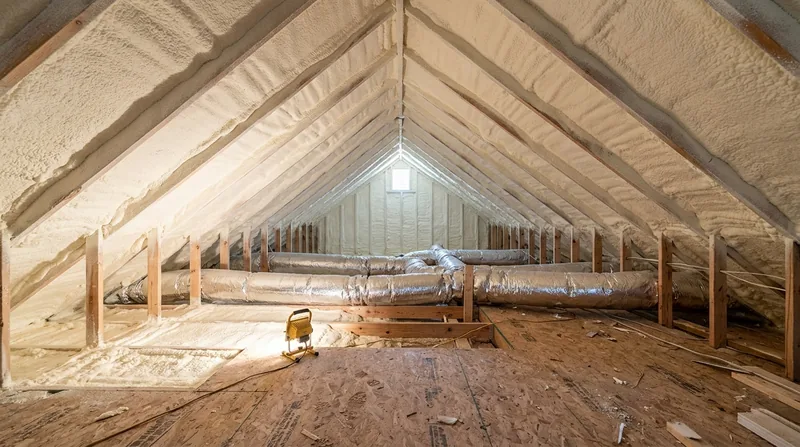




Atlanta's attic insulation challenge is brutal and specific. Most homes sit on sloped red-clay lots with vented attics that bake at 130 to 150 degrees Fahrenheit from May through September. The air handler and ductwork run overhead in that unconditioned space, bleeding cool air through leaky ducts while the roof deck radiates heat straight down onto fiberglass batts that sag, settle, and leave thermal gaps at the rim and band joist. Inside the Perimeter, 1900s Craftsman bungalows and Victorian cottages have empty wall cavities and raised foundations; outside, 1980s to 2020s two-stories with two-story foyers and vaulted great rooms push hot air into finished spaces that never cool. Attic spray foam insulation in Atlanta solves this by converting that 150-degree attic into conditioned space. Open-cell foam on the roof deck seals the air leaks, brings the air handler and ducts inside the thermal envelope, and turns the attic into part of the house instead of a furnace. Every estimate lists the R-value target, the thickness per pass, and the board footage so you know what you are buying.
Why Attic Spray Foam Insulation Matters in Atlanta's Heat and Humidity
Georgia's humid subtropical climate means long, muggy summers with thunderstorms that put trees on roofs, mild winters with a few hard freezes, and steady moisture pressure that turns a vented attic into a condensation factory. Fiberglass batts absorb humidity; the insulation value drops; and mold and mildew thrive in the dark, damp space above your head. Blown-in cellulose settles and compacts, leaving voids at the rim and eaves where the attic meets the walls. Spray foam adheres to every surface, seals every leak, and stops air movement cold. The air handler no longer has to cool 150-degree air leaking out of ducts; the conditioned space shrinks to the actual living area; and your cooling bills drop because the system is not fighting physics anymore.
- Foam seals rim joists, band joists, and eave gaps where fiberglass leaves thermal bridges and air leaks.
- Closed-cell foam on the roof deck controls humidity and condensation that destroys traditional insulation in Georgia's climate.
- Open-cell foam on the roof deck is cheaper, lighter, and turns the attic into a conditioned space without the weight penalty of closed-cell.
- Air sealing around the HVAC ductwork stops cooled air from bleeding into the unconditioned attic and wasting energy.
A properly insulated and sealed attic stops the cycle of moisture, mold, and heat loss that plagues Atlanta homes. For more detail on how closed-cell and open-cell differ in this climate, see our guide to closed-cell spray foam insulation.
Key info: Attic ventilation, ignition barriers, and thermal barriers are governed by the energy and building code in force at your address and by your local building official, not by us. The fifteen-minute thermal barrier distinction is the one most installers get wrong. Naming it correctly is the expertise signal that separates a professional from a rig-and-run crew.
For permitting guidance specific to your address, contact your city or county building department. Atlanta, Decatur, Marietta, and Alpharetta each have their own code enforcement offices and registration rules, and there is no reciprocity between them. We help you navigate what applies at your location, and we defer to the local official.
How We Spray Foam and Seal Your Atlanta Attic: The Process
The job starts with a walk-through of your attic, a measurement of the square footage, a review of the existing insulation and any moisture damage, and a check of the roof deck, rim board, and band joist condition. We calculate the R-value target based on your climate zone and code, determine whether open-cell or closed-cell foam is the right fit, and estimate the thickness per pass and the total board footage. Every estimate is written with R-value and thickness specs so you know exactly what you are buying and can compare it to other quotes. Once you approve, we schedule the work, protect your home and belongings, set up mechanical ventilation to exhaust fumes during cure, and spray the foam in controlled passes to the specified thickness. After the foam cures, we verify the coverage, seal any gaps or voids, and remove the temporary ventilation once the re-entry window has passed (typically 24 to 48 hours for open-cell, longer for closed-cell in cool weather). The result is a sealed, insulated attic with no air leaks, no thermal bridges, and no settling or compaction over time.
- We measure the attic, assess the existing insulation, and identify any moisture or damage before writing an estimate.
- Every estimate includes the R-value target, thickness per pass, board footage, and the choice of open-cell or closed-cell foam.
- We set up mechanical ventilation during cure to exhaust isocyanate and polyol vapors so you can safely re-enter after the window closes.
- We spray the foam in controlled passes, verify coverage with a thickness gauge, and seal any voids before cleanup.
- We remove temporary ventilation once the foam has cured, and we schedule a final walkthrough to confirm the job meets code and your expectations.
The entire process, from estimate to cure, typically takes 2 to 5 days depending on attic size, weather, and how much existing insulation we need to remove. For more on removal and replacement, see insulation removal.
Local example: A 1950s brick ranch in Smyrna with a 1,200-square-foot attic, original blown-in insulation that has settled to R-13, and a vented attic at 145 degrees in August. We remove the old insulation, spray 5.5 inches of open-cell foam to R-19.8 on the roof deck, seal the rim and band joists with closed-cell, and bring the air handler into the conditioned space. The attic becomes a sealed, insulated buffer; the cooling load drops by 20 to 30 percent; and the homeowner stops hearing the air handler roar at full capacity on hot afternoons.
| Approach | Description | Best for |
|---|---|---|
| Open-Cell Spray Foam | Low-density foam sprayed to 5 to 6 inches, R-3.5 to R-3.8 per inch. Flexible, breathable, allows drying. Cures in 24 hours. | Attic roof decks, sealed attics, soundproofing, and homes where cost and weight matter more than vapor barrier performance. |
| Closed-Cell Spray Foam | High-density foam sprayed to 1.5 to 3 inches, R-6 to R-7 per inch. Vapor barrier, moisture barrier, structural rigidity. Cures in 24 to 48 hours depending on temperature. | Rim joists, band joists, metal buildings, crawl spaces, and attics where condensation control and structural strength are priorities. |
| Hybrid (Open-Cell + Closed-Cell) | Closed-cell on rim, band, and eave gaps; open-cell on the roof deck. Maximizes R-value, seals air leaks, controls moisture, and balances cost. | Atlanta attics with moisture risk, existing ductwork that needs sealing, and homes where performance and budget both matter. |
| Removal and Re-Spray | We remove failed, contaminated, or settled insulation, dispose of it properly, and spray new foam to spec. Includes substrate prep and moisture assessment. | Attics with old fiberglass, blown-in cellulose that has compacted, water damage, or previous foam that failed or smells. |
Attic Spray Foam Insulation Cost in Atlanta: What to Expect
Spray foam pricing in Atlanta starts at around $1.50 per square foot for open-cell on the roof deck, and climbs to $3.00 to $4.50 per square foot for closed-cell or hybrid jobs with rim and band joist sealing included. A typical 1,200-square-foot attic with open-cell spray foam runs $1,800 to $2,400 before removal of existing insulation; adding removal, closed-cell on the rim, and air sealing around ductwork pushes the total to $2,800 to $4,200. The factors that move the price are attic size, accessibility, how much old insulation we remove, whether the substrate is wet or contaminated, and whether you want open-cell, closed-cell, or a hybrid approach. A second-story attic in a Sandy Springs colonial is easier to access and cheaper per board foot than a cramped crawlspace attic in a Lawrenceville ranch. A roof deck with active moisture or mold requires drying and substrate prep before we spray, and that adds cost and time. Getting 2 to 3 estimates from local contractors is the only way to understand what you are actually paying for and to spot low-ball quotes that skip ventilation, underestimate thickness, or promise immediate re-entry.
For a detailed breakdown of pricing by service and job size, see our full pricing guide. Call us at (678) 931-8735 for a free, no-obligation estimate with written R-value and thickness specs.
Attic Spray Foam Insulation Near Me: What to Look for When Hiring a Contractor
The spray foam trade has two types of operators: local independents with a shop address and local plates, and rig-and-run crews with an out-of-state trailer who spray a job in an afternoon and disappear when the smell will not go away or the foam fails. The differentiator is honesty, local accountability, and correct technique. A professional contractor gives you a written estimate with R-value and thickness specs so you can compare apples to apples. They set up mechanical ventilation during cure, state the re-entry window clearly (24 to 48 hours for open-cell), and never promise immediate occupancy. They pull permits if your local code requires them, they carry fully insured coverage that can be verified, and they are reachable if you have a question or a problem after the job closes. They also know the difference between open-cell and closed-cell, and they recommend based on your use case, not on what makes the biggest margin. If a contractor gives you an estimate with no R-value, no thickness, and a price far below market, walk away. If they promise immediate re-entry or deny that the foam has any odor or off-gassing, walk away. If their insurance cannot be verified or their phone number goes to voicemail, walk away.
- Ask for a written estimate with R-value target, thickness per pass, board footage, and the choice of foam type clearly stated.
- Verify that the contractor is fully insured and ask for a copy of the certificate of insurance naming you as additional insured.
- Check references from Atlanta-area jobs completed in the last 12 months and call at least two of them to ask about odor, cure time, and post-job support.
- Confirm that the contractor will set up mechanical ventilation during cure and will state the re-entry window in writing.
- Ask whether permits are required at your address and whether the contractor will help you navigate the local building department.
- Get 2 to 3 estimates from different contractors and compare not just the price but the scope, the materials, and the warranty.
For a free estimate from a local Atlanta contractor with 12 years in the trade, contact us today. We respond within 24 hours and we never pressure you to book before you are ready.
Attic Spray Foam Insulation in Atlanta: Pricing Guide
| Service | Price | Details |
|---|---|---|
| Open-Cell Spray Foam, Roof Deck | Starting at $1.50/sq ft | Includes 5 to 6 inches sprayed to R-19.8 minimum, mechanical ventilation during cure, standard cleanup. Attic size and accessibility adjust the rate. |
| Closed-Cell Spray Foam, Rim and Band Joists | Starting at $2.50/sq ft | Includes 1.5 to 3 inches sprayed to R-9 to R-21, vapor barrier, structural rigidity. Smaller surface area but higher material cost and density. |
| Hybrid (Open + Closed), Full Attic Seal | Starting at $2.00/sq ft | Open-cell on roof deck, closed-cell on rim and band joists, air sealing around ductwork. Balances performance, cost, and moisture control for Atlanta's climate. |
| Removal of Existing Insulation | Starting at $0.75/sq ft | Includes bagging, hauling, and disposal of old fiberglass, blown-in cellulose, or failed foam. Wet or contaminated substrate may require additional drying time. |
| Travel and Mobilization | Included | No separate charge for Atlanta and surrounding service areas. Estimate response within 24 hours at (678) 931-8735. |
| Free Written Estimate | No cost | Every estimate includes R-value, thickness, board footage, and foam type. No obligation to book. Includes a site walkthrough and moisture assessment. |
Indicative pricing, the exact cost depends on square footage, finish, and site access. Free personalized estimate within 24h at (678) 931-8735.


