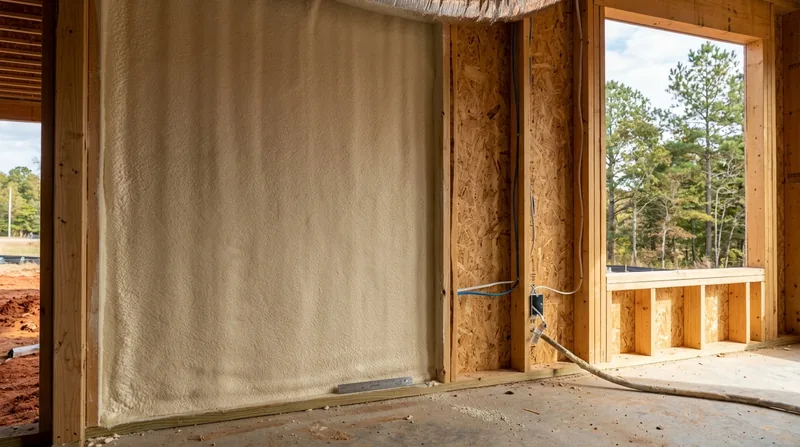




Closed cell spray foam insulation in Atlanta is the high-performance answer to the moisture and heat load that defines this region. Atlanta sits on the Piedmont under dense tree canopy, with homes built on red-clay slopes over vented crawl spaces that sweat from May through September. Above most of those homes, attics bake at 130 to 150 degrees Fahrenheit while humidity pushes relentlessly against every surface. Two-pound closed-cell foam delivers R-6.5 per inch with its own vapor retarder, structural stiffening, and the moisture control that open-cell foam cannot match. Whether you own a 1920s Craftsman bungalow in Virginia-Highland, a brick ranch in Brookhaven, or a two-story subdivision home in Alpharetta, closed-cell foam stops the heat, seals the air leaks, and stands up to Georgia's humidity without fail. We have been doing this work since 2012, and we know what works in this climate.
Why Closed-Cell Spray Foam Matters in Atlanta's Humid Subtropical Climate
Atlanta's climate is the enemy of fiberglass and blown-in cellulose. The combination of high humidity, long hot summers, and moisture rising from crawl spaces over red clay means that traditional insulation absorbs water, loses R-value, and fails silently. Closed-cell foam does not absorb moisture, does not settle, and does not lose performance over time. It also acts as a vapor retarder, which is critical in a climate where crawl space humidity and attic condensation are constant threats.
- Closed-cell foam resists moisture absorption in crawl spaces and daylight basements where humidity is the dominant failure mode.
- The material provides structural stiffening to roof decks and wall cavities, which matters in metal buildings and retrofitted attics.
- A properly installed closed-cell system stops air infiltration at the thermal boundary, which is the single biggest reason homes stay uncomfortable in summer.
- Unlike fiberglass, closed-cell foam does not compress, settle, or degrade when exposed to humidity cycles over decades.
- The vapor retarder is integral to the material, which eliminates the need for separate poly sheeting that tears and fails.
These are not theoretical advantages. They are the reason closed-cell foam is the standard in metal buildings across rural Henry, Cherokee, and Forsyth County, where condensation on uninsulated steel is a production-line problem.
Key info: Georgia's building code and energy code govern attic ventilation and thermal barrier requirements at your address. Always verify what applies with your local building department before work begins. We help you navigate those requirements, but the final authority is the building official in your jurisdiction.
For detailed guidance on what applies in your area, contact the Georgia Department of Community Affairs, which administers the state energy code.
How We Install Closed-Cell Spray Foam in Atlanta Homes and Buildings
Closed-cell foam installation is a controlled process. We start with a site inspection to identify the substrate, check for moisture, and establish the scope. We then prepare the space, set up mechanical ventilation for the cure period, and spray the foam in controlled passes to hit the specified thickness and R-value. The material cures over 24 to 48 hours, and we do not allow re-entry until the cure window is complete. This is not a same-day-spray-and-occupy job. The difference between a proper installation and a rushed one is the difference between a home that stays dry and comfortable for decades and one that smells, sweats, and fails.
- We inspect the substrate, identify any moisture or contamination, and address it before foam goes down.
- We set up mechanical ventilation and establish a re-entry window of 24 to 48 hours, which we communicate in writing.
- We spray in passes of specified thickness, maintain the correct drum temperature and ratio, and document the work with photos and R-value specs.
- We seal all rim and band joists, air gaps around penetrations, and thermal boundaries to stop convective loss.
- We provide a written estimate with R-value, thickness, and board-foot calculation before we start.
A homeowner in Decatur with a 1950s ranch and a damp crawl space does not call us because we are the cheapest. They call us because they have already tried fiberglass batts that absorbed moisture, settled, and left gaps. They want a product that stops the problem at the root.
Local example: A sealed attic retrofit in Sandy Springs requires closed-cell foam on the roof deck to prevent condensation during winter, plus foam at the rim joist and any band joist to stop convective loss. We also seal ductwork penetrations, light fixtures, and the top of the exterior wall. The whole job is documented with R-value per pass and board-foot totals.
For more details on how closed-cell foam integrates with other air-sealing work, see our air sealing service page.
Closed-Cell Spray Foam Installation Methods
| Approach | Description | Best for |
|---|---|---|
| Sealed roof deck retrofit | Two-pound closed-cell foam sprayed to 4 to 6 inches on the underside of roof sheathing, creating an unvented attic and eliminating soffit vents. | Attics with ductwork, finished rooms, or moisture issues; homes in Alpharetta, Roswell, and Johns Creek with vaulted great rooms. |
| Crawl space wall insulation | Closed-cell foam sprayed to 2 to 3 inches on foundation walls and rim band, with the material acting as both insulation and vapor retarder. | Vented crawl spaces over red clay with humidity and moisture; standard retrofit in Brookhaven, Smyrna, and Decatur. |
| Metal building and barndominium | Closed-cell foam sprayed to 2 to 4 inches on the underside of metal roof and walls, eliminating condensation and providing structural bracing. | Agricultural buildings, workshops, barndominiums, and metal shops in rural Forsyth, Cherokee, and Paulding County. |
| Wall cavity injection foam | Low-pressure closed-cell foam injected into existing wall cavities of 1920s to 1960s homes without removing siding or drywall. | Craftsman bungalows and brick ranches with empty cavities; retrofit of historic stock in Virginia-Highland, Inman Park, and Grant Park. |
| Daylight basement and rim joist | Closed-cell foam sprayed to 2 to 3 inches on the rim band, band joist, and foundation wall above grade to stop heat loss and moisture entry. | Homes built on sloped lots with daylight basements or finished basements; common in Atlanta's Piedmont neighborhoods. |
Closed Cell Spray Foam Insulation Cost in Atlanta: What to Expect
Closed-cell spray foam in Atlanta starts at approximately $1.20 per board foot, though the final price depends on several factors specific to your home and the scope of work. A crawl space wall retrofit in a Brookhaven ranch might run 800 to 1,200 board feet and cost between $960 and $1,440 in material and labor. A sealed attic retrofit on a 2,000-square-foot home in Alpharetta with ductwork and rim joist work could easily run 2,000 to 3,000 board feet and cost $2,400 to $3,600 or more. Metal buildings and barndominiums in rural areas outside the Perimeter are often larger jobs, sometimes 5,000 to 10,000 board feet, which shifts the total cost significantly.
What moves the price within that range? Access to the space (a finished attic costs more to work in than an open one). The substrate condition (we will not spray over wet, contaminated, or leaking surfaces, and fixing those issues first adds cost). The complexity of the thermal boundary (a simple sealed attic is faster than a crawl space wall with rim joist, rim band, and band joist all needing foam). Whether existing insulation needs to be removed first. And the travel distance within Atlanta and surrounding areas (we cover the whole metro area with no separate mileage fee).
The honest way to get a real number is to request a free written estimate. We measure the space, document the substrate, and give you a board-foot total with R-value and thickness specs before you commit. We respond within 24 hours at (678) 931-8735. You should also get 2 to 3 other estimates so you can compare scope, not just price. The cheapest estimate is often the one that skips the details.
For a detailed pricing breakdown by service type, see our full pricing page.
What to Look for When Hiring a Closed Cell Spray Foam Contractor Near Me in Atlanta
Not all spray foam contractors are the same. Some are local shops with a local address and a reputation to protect. Some are national franchises with rotating crews. Some are one-off operators working out of a trailer who disappear when the job smells or the warranty question comes up. Here is what to verify before you sign a contract.
- Ask for proof of full insurance coverage, including general liability and workers compensation, and verify the policy is current.
- Request a written estimate that includes R-value per inch, thickness in inches, board-foot total, and a clear scope of work.
- Ask for references from homes or buildings completed in the last 12 months in Atlanta or nearby areas, and call at least two.
- Confirm that the contractor understands your local building code and can explain what permits apply at your address.
- If your home is in an HOA, ask whether the contractor has experience with HOA approval processes for exterior work like metal building or garage insulation.
- Verify that the contractor will use mechanical ventilation during cure and will state a re-entry window in writing before starting.
A contractor who gives you a price with no R-value, no thickness, no board-foot calculation, and no written scope is not ready to do the work. A contractor who promises immediate re-entry or guarantees no smell is either inexperienced or dishonest. A contractor who cannot show you insurance or references is not someone you want in your crawl space or attic.
When you are ready to talk to someone, contact us for a free estimate. We have been in Atlanta since 2012, we work year-round, and we are fully insured. You can verify our track record with homeowners and builders across the metro area.


