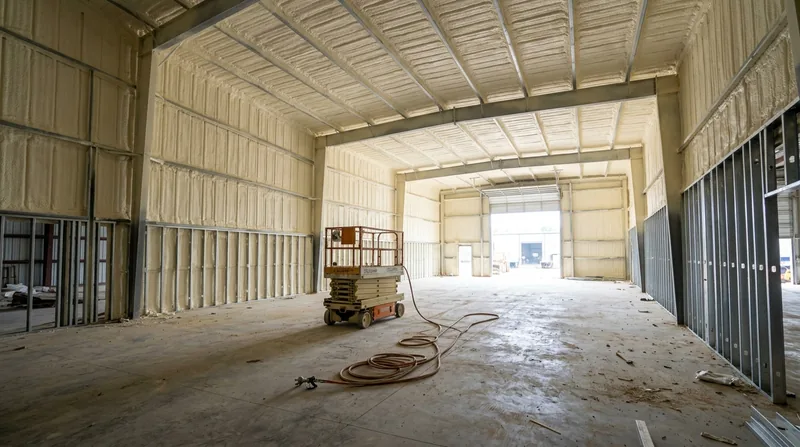




Commercial and new construction projects across the Atlanta metro demand spray foam insulation and air sealing that meets code on the first inspection and keeps schedules on track. From the airport logistics belt in south Fulton through the studio district near Fayetteville and across the Gwinnett warehouse corridor, warehouses, offices, churches, soundstages and production shells require insulation systems that are documented, defensible, and installed to specification. Atlanta's humid subtropical climate, long muggy summers, hard freezes in winter, and thunderstorms that test every assembly, means that moisture control and thermal performance must be engineered into the build from day one. Whether you are finishing a new shell, retrofitting an existing commercial envelope, or sealing a metal building against condensation, the difference between a code-compliant installation and a failed one comes down to controlled application, the right material for the use, and a local contractor who knows what your building official will actually accept.
Why Commercial & New Construction Spray Foam Matters in Atlanta's Building Landscape
Atlanta's commercial and light industrial footprint spans from dense urban warehouses in Clayton County to sprawling logistics parks along I-85 and I-75, with soundstages and production facilities clustered near Fayetteville and Peachtree City. Most of these buildings are metal-framed shells with corrugated steel or metal deck roofing, and metal conducts heat and cold without resistance. In summer, a metal roof can climb to 150 degrees Fahrenheit; in winter, the steel deck becomes a thermal bridge that radiates cold into the conditioned space below. Without proper insulation and air sealing, condensation pools on the underside of the deck, drips onto equipment and inventory, and triggers mold growth that can shut down operations. Spray foam insulation solves this by creating a continuous thermal and moisture barrier that stops condensation before it starts.
- We seal metal building envelopes with closed-cell foam to stop condensation and thermal bridging on corrugated and metal deck roofs.
- We insulate new construction shells during the framing and MEP phase, so thermal barriers and code compliance are built in from day one.
- We air-seal the perimeter, rim, and all penetrations so your HVAC system does not waste conditioned air through leaks.
- We provide written estimates with R-value and thickness specifications so your local building department has the documentation it needs to approve the work.
- We phase work around your operational schedule, so warehouses, studios, and production facilities stay open and on time.
Code-compliant spray foam insulation is not a commodity; it is a system that must be installed to manufacturer specifications, documented for the inspector, and verified by a local contractor who knows the Atlanta building code and the officials who enforce it.
Key info: Atlanta's building code requires thermal barriers on spray foam in most commercial assemblies, and the fifteen-minute thermal barrier distinction (the membrane that separates the foam from occupied space) is the most commonly misunderstood rule. Your local building department, not the contractor, determines what applies at your address. We defer to the code and provide documentation that your inspector will accept.
For detailed guidance on what applies to your project, check with your local building department or visit the Georgia Department of Community Affairs for state-level code resources.
How We Install Commercial & New Construction Spray Foam: Process and Phasing
Commercial and new construction spray foam installation is not a one-afternoon job. We work with your general contractor, project manager, and local building official to plan the installation so it fits your schedule and meets code at every step. The process begins with a site survey to measure the building envelope, identify all penetrations and thermal bridges, and confirm the material and thickness that your design engineer has specified. We then schedule the work during your construction phase, typically after the structure is closed but before drywall, so we can reach all surfaces and ensure complete coverage. On metal buildings, we spray the underside of the deck and the interior of the walls; on new construction shells, we insulate roof decks, exterior walls, and rim joists. Mechanical ventilation runs during application and cure, and we enforce a re-entry window of twenty-four to forty-eight hours before occupied use.
- We conduct an on-site survey and measure the building envelope to confirm the scope and material specifications.
- We coordinate with your GC and building official to schedule the work during the construction phase when access is easiest.
- We apply the foam to the specified thickness in controlled passes, using drum heaters and ratio controllers to ensure manufacturer specifications are met.
- We set up mechanical ventilation during application and cure to manage off-gassing and keep the site safe.
- We provide a written report with photographs, R-value calculations, and thickness documentation for your building permit file.
A typical commercial metal building insulation project takes one to three days depending on square footage and access; a new construction retrofit of a large office shell may span a week or more in phases. Our crews work early mornings or evenings to minimize disruption to your operations.
Example: A 40,000-square-foot logistics warehouse in Gwinnett County with a corrugated metal roof and no insulation was losing conditioned air through the uninsulated deck and experiencing condensation that dripped onto stored goods. We sprayed 2 inches of closed-cell foam on the underside of the roof deck and sealed all perimeter penetrations. The building stayed dry, the HVAC system ran more efficiently, and the installation passed inspection on the first visit because we provided the documentation the inspector needed.
For more information on how we handle closed-cell spray foam for metal buildings and condensation control, see our metal building service page.
Spray Foam Methods for Commercial and New Construction
| Approach | Description | Best for |
|---|---|---|
| Closed-Cell Spray Foam | High-density foam (3.5 to 4.5 lbs/cu ft) with an R-value of 6 to 7 per inch. Forms a continuous moisture barrier and thermal break. Low permeability stops vapor and condensation. | Metal building roofs and walls where condensation is the failure mode. New construction envelopes where thermal performance and code compliance must be guaranteed. Rim and band joists in humid climates. |
| Open-Cell Spray Foam | Lower-density foam (0.5 to 1.5 lbs/cu ft) with an R-value of 3.5 to 4 per inch. Vapor-permeable, so moisture can pass through. Lighter, easier to handle, and less expensive per board foot. | New construction where the roof deck is vented or the wall cavity has a vapor barrier on the warm side. Sound dampening in studios and production facilities. Budget-conscious projects where moisture control is not the primary concern. |
| Injection Foam Retrofit | Low-pressure injection of foam into existing wall cavities without demolition. Typically 1 to 2 inches of closed-cell foam injected through small holes drilled from the exterior or interior. | Existing commercial buildings with empty wall cavities. Historic or heritage buildings where exterior appearance must be preserved. Retrofit energy upgrades where downtime must be minimized. |
| Combination: Spray + Air Sealing | Spray foam applied to the primary envelope (roof, walls) combined with caulk and sealant at all penetrations, seams, and thermal bridges. Creates a complete thermal and air barrier. | All commercial and new construction projects. The spray foam stops conduction and convection; the air sealing stops infiltration and exfiltration. Code compliance and energy performance depend on both. |
Each method has a specific use case. The choice depends on your building type, the climate, the existing envelope, and the code requirements at your address. A local contractor who knows Atlanta's building stock and building officials can help you choose the right approach.
Commercial & New Construction Spray Foam Cost in Atlanta: What to Expect
The cost of spray foam insulation for commercial and new construction projects in Atlanta depends on the building type, the square footage, the material (closed-cell or open-cell), the thickness required by code or design, and the complexity of the envelope. A metal building with a simple corrugated roof and no existing insulation will cost less per square foot than a multi-story office shell with a complex roof deck, multiple mechanical penetrations, and air-sealing requirements. We provide a free commercial estimate on site, where we measure the building, identify all surfaces to be insulated, confirm the material and thickness specified by your design engineer, and give you a firm price based on board footage and labor.
Closed-cell foam typically costs more per board foot than open-cell, but it delivers higher R-value per inch and provides the moisture control that metal buildings require. Open-cell foam is less expensive and works well for new construction where the roof is vented or the wall cavity has a vapor barrier. Air sealing, caulk, sealant, and gaskets at all penetrations, adds cost but is essential for code compliance and energy performance. Most commercial projects in the Atlanta area run from a few thousand dollars for a small retrofit to tens of thousands for a large metal building or new construction shell, depending on scope.
Travel within Atlanta and surrounding areas is included in our estimate; there is no separate mileage fee. For a detailed breakdown of what affects pricing, see our full pricing page. Call us at (678) 931-8735 for a free estimate with no obligation to book.
Key info: The biggest cost drivers are the square footage of the building envelope, the thickness of foam required by code or design, and whether you need air sealing in addition to the primary insulation. A metal building 50 feet by 100 feet with a single corrugated metal roof will cost significantly less than a two-story office shell with a complex roof deck, multiple wall assemblies, and dozens of mechanical and electrical penetrations. Get 2 to 3 estimates from local contractors so you can compare scope, material, thickness, and price.
What to Look for When Hiring a Commercial Spray Foam Contractor Near Atlanta
Hiring the right spray foam contractor for your commercial or new construction project is one of the most important decisions you will make, because a poor installation will fail to meet code, will not perform as designed, and can be expensive to correct. The market includes local independent shops, regional franchises, and out-of-state crews who show up, spray, and disappear. The best contractor is the one who is reachable, who provides written estimates with R-value and thickness specifications, who coordinates with your building official and GC, and whose work is fully insured and documented.
- Verify that the contractor is fully insured and can provide a certificate of insurance naming your project and your general contractor as additional insured.
- Ask for written estimates that include the material (closed-cell or open-cell), the thickness in inches, the R-value per inch, the total board footage, and the labor and material cost per board foot.
- Check references from other commercial or new construction projects completed in the Atlanta area, and ask the GC or property manager whether the work passed inspection on the first visit and whether the contractor was responsive after the job.
- Confirm that the contractor understands the local building code and the thermal barrier requirements at your address, and that they will provide documentation for your building official.
- Avoid contractors who promise immediate re-entry, who offer no written estimate, or whose price is far below market; these are signs of poor workmanship and unverified insurance.
A local contractor who has been in business for years, who knows the Atlanta building officials and their expectations, and who stands behind their work with a written warranty is worth the investment. Contact us at (678) 931-8735 for a free estimate and to discuss your project timeline and code requirements.
Atlanta Spray Foam Insulation has served commercial and new construction projects across the Atlanta metro since 2012. We spray warehouses, offices, churches, soundstages, and production facilities on schedule, with code-compliant assemblies and documentation your inspector will accept. Call (678) 931-8735 for a free commercial estimate today.
Commercial & New Construction Spray Foam in Atlanta: Pricing Guide
| Service | Price | Details |
|---|---|---|
| Free Commercial Estimate | Free | On-site survey, envelope measurement, material and thickness specifications, scope and pricing, no obligation |
| Closed-Cell Spray Foam | From $1.50 to $2.50 per board foot | Labor and material, 2 to 4 inches typical, includes air sealing at penetrations and thermal bridges |
| Open-Cell Spray Foam | From $0.90 to $1.40 per board foot | Labor and material, 4 to 6 inches typical for R-value equivalent, lower cost, vapor-permeable |
| Metal Building or Large Commercial Shell | On estimate | Scope, square footage, roof type, and complexity determine final price; phasing and schedule coordination included |
| Travel and Scheduling | Included | No separate mileage or travel fee within Atlanta and surrounding service areas; phased work coordinated with your GC |
| Estimate Turnaround | Free | Response within 24 hours, written quote with R-value and thickness, valid for 30 days |
Indicative pricing, the exact cost depends on square footage, finish, and site access. Free personalized estimate within 24h at (678) 931-8735.


