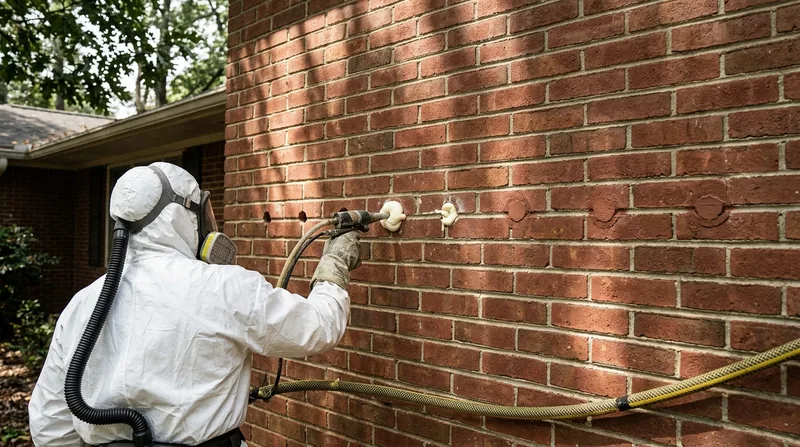




Wall and injection foam insulation in Atlanta fills the empty cavities of pre-1980 homes without tearing into walls. Atlanta's 1920s Craftsman bungalows in Virginia-Highland, Inman Park, and Grant Park, along with the 1950s-60s brick-veneer ranches that blanket Decatur, Smyrna, and Tucker, were built with frame walls or cavity masonry that sits uninsulated. Injection foam is drilled through small ports under a siding course or along a mortar joint, then sealed and patched to match. No demolition, no drywall replacement, no weeks of disruption. For homeowners on the red-clay Piedmont where humidity and summer heat drive every cooling choice, filling those cavities is the difference between an attic that bakes at 150 degrees and one that stays 10 to 15 degrees cooler. We have been doing this work since 2012, and we know the stock that surrounds you.
Why Wall and Injection Foam Matters in Atlanta's Older Neighborhoods
Atlanta's in-town and inner-ring homes were built before modern insulation standards. The cavity walls of these houses leaked air and heat for decades, and no retrofit method has been faster or less disruptive than injection foam. The foam fills the entire cavity from top to bottom, seals air leaks at the same time, and stops the thermal bridge that masonry and framing create. In a Kirkwood or Candler Park bungalow, the difference between a wall insulated with injection foam and one left bare is 10 to 15 degrees of surface temperature on a summer afternoon. That cools the interior, cuts the run time of the air handler, and reduces moisture load in the humid subtropical climate that defines Atlanta.
- Injection foam reaches into cavities that fiberglass and cellulose cannot fill, sealing air leaks and bridging thermal gaps at the same time.
- Ports are drilled in inconspicuous locations under siding courses or along mortar joints and patched to match the existing finish.
- The work is complete in one day for most homes, with no interior demolition, no weeks of drywall replacement, and no disruption to landscaping.
- Closed-cell injection foam carries an R-value of 6.5 to 7.0 per inch, so a 3.5-inch cavity receives R-20 to R-24.5 of insulation.
- The foam cures fully in 24 to 48 hours, after which the home is reoccupied normally and the ports are sealed with matching caulk or siding patches.
Older neighborhoods benefit most because the homes were never insulated to begin with, and injection foam is the only retrofit that does not require a gut renovation.
Key info: Atlanta's 1920s and 1950s homes sit on vented crawl spaces over red clay and face 130-150 degree attic temperatures in summer. Injecting foam into cavity walls reduces surface temperatures, lowers interior humidity, and cuts HVAC runtime during the five-month cooling season. Permits and thermal barrier requirements vary by city, so we verify what applies at your address with the local building department.
For guidance on what permits and building code requirements apply at your specific address, contact the building department in your city (Atlanta, Decatur, Smyrna, Sandy Springs, etc.). Code and permitting vary by jurisdiction and are enforced by the local official, not by us.
How We Inject Foam Into Walls: The Atlanta Process
Injection foam is a measured, methodical process. We locate the cavity boundaries, drill small access ports (typically 1 to 2 inches in diameter) in locations that can be sealed afterward, and inject closed-cell foam at a controlled rate. The foam expands slightly as it cures, filling the entire depth of the cavity and sealing air leaks around electrical outlets, rim joists, and band beams. We use mechanical ventilation during cure to manage odor and off-gassing, and we specify a 24 to 48 hour re-entry window before the home is fully occupied. On a 1,500 square foot home in Brookhaven or Johns Creek, the work typically takes 6 to 10 hours, and the cavity is fully insulated and air-sealed when we leave.
- We conduct a free on-site estimate, identify cavity boundaries, and check for moisture or contamination that would prevent foam installation.
- We drill access ports under siding courses, along mortar joints, or in other inconspicuous locations that can be sealed and patched afterward.
- We inject closed-cell foam at the manufacturer's specified ratio and drum temperature, filling the cavity from top to bottom at a controlled rate.
- We install mechanical ventilation to manage cure-time odor and off-gassing, keeping interior air quality within safe limits.
- We seal all ports with foam plugs, caulk, or matching siding patches, restoring the exterior finish to its original appearance.
- We provide a 24 to 48 hour re-entry window and written documentation of R-value and thickness specifications for your records and any future work.
The process is straightforward, and the result is permanent insulation and air sealing in walls that were never insulated before.
Example: A 1930s Craftsman bungalow in East Atlanta with lap siding over frame walls and empty cavities receives injection foam through 8 to 12 small ports drilled under the siding course. The foam expands into the cavity, seals the rim joist, fills around the band beam, and stops the air leaks that pulled humid air into the wall cavity during summer. Ports are patched with matching caulk and siding trim. Interior drywall is never disturbed, and the work is complete in one day.
For more information on how air sealing complements injection foam and reduces your overall heating and cooling load, visit our air sealing page.
Injection Foam Methods and Material Comparison
| Approach | Description | Best for |
|---|---|---|
| Closed-Cell Injection | High-density foam injected into cavities, R-6.5 to R-7.0 per inch, fully cures in 24 to 48 hours. | Cavity walls in 1920s-1950s homes, moisture-prone areas, and homes where air sealing is critical. |
| Open-Cell Injection | Lower-density foam, R-3.5 to R-4.0 per inch, breathable, better for sound dampening but not recommended in humid climates. | Interior wall cavities in dry climates or where sound control is a priority, rarely chosen in Atlanta due to humidity. |
| Fiberglass or Cellulose Top-Up | Blown-in insulation added to existing cavities, R-3.5 to R-4.0 per inch, does not air-seal. | Supplementing existing insulation when cavity depth is limited and budget is tight, but does not address air leaks. |
| Demolition and Cavity Replacement | Interior or exterior drywall removed, cavity insulated with batt or foam, drywall replaced, interior finishes restored. | Homes where interior work is already planned, walls are damaged, or cavity depth is unknown and needs verification. |
Closed-cell injection foam is the standard choice for Atlanta homes because it seals air leaks, handles moisture without risk, and delivers R-value in a thin cavity. We do not recommend open-cell foam in the humid subtropical climate of Atlanta, and we always recommend closed-cell injection over fiberglass top-up when air sealing is the goal.
Wall and Injection Foam Insulation Cost in Atlanta: What to Expect
Wall and injection foam insulation in Atlanta typically starts at $2 per square foot of wall cavity and rises based on the size of the home, the number of cavities, access difficulty, and the need for port patching or siding repair. A 1,500 square foot home with 2,000 to 2,500 square feet of exterior wall area can expect a cost range of $4,000 to $6,500 for full cavity filling with closed-cell foam, including all ports and patches. Larger homes, homes with complex exterior finishes (stone, premium siding), or homes where ports require masonry drilling or matching mortar work will cost more. Smaller jobs, such as a single addition or a wall section, cost less per square foot because setup time is fixed.
Several factors move the cost up or down. Access difficulty (homes on slopes, surrounded by trees, or with limited staging area) increases labor time. Exterior finish type (lap siding, brick, stucco, stone) affects patching cost and time. The presence of existing insulation, debris, or moisture in the cavity can require cleanup or remediation before foam is installed. We always provide a free written estimate with R-value and thickness specifications, so you know exactly what you are paying for and why.
Getting 2 to 3 estimates from different contractors is smart practice. Look for estimates that specify R-value, thickness, the type of foam (closed-cell vs. open-cell), the number of ports, and what patching or finish restoration is included. Estimates that skip these details, quote a price far below market without inspection, or promise immediate re-entry are red flags. Visit our full pricing page for more details on cost factors and how we structure estimates.
Wall and Injection Foam Insulation Near Me: What Atlanta Homeowners Should Know Before Hiring
Hiring a spray foam insulation contractor for wall injection is a significant decision, and it pays to verify a few key things. First, confirm that the contractor is fully insured and carries liability coverage for spray foam work. Ask to see a current certificate of insurance and verify the coverage limits. Second, get written estimates from at least two contractors, and compare them side by side on R-value, thickness, foam type, and what is included in the price. Third, ask for references from homes in your neighborhood (Brookhaven, Smyrna, Decatur, Alpharetta, etc.) and call them to ask about odor, cure time, and whether the contractor was reachable if questions came up after the job.
Permitting and building code requirements vary by city. Atlanta, Decatur, Smyrna, Sandy Springs, Johns Creek, and other cities in the metro area have different rules about thermal barriers, ignition barriers, and whether a permit is required for injection foam in cavity walls. Before you hire, ask your contractor to confirm what applies at your address and whether a permit is needed. The contractor should be willing to help you navigate permitting, but the building department for your city has the final say. If your home is in an HOA, check the architectural guidelines to see whether the drilling and patching of exterior walls requires approval. Most HOA rules do not touch interior insulation, but it is worth asking.
Call us at (678) 931-8735 for a free estimate and to discuss what applies at your specific address. We have been serving Atlanta, Marietta, Alpharetta, Roswell, Sandy Springs, Johns Creek, Decatur, Smyrna, and surrounding areas since 2012, and we know the local building codes and the stock that makes up each neighborhood.
Wall & Injection Foam Insulation in Atlanta: Pricing Guide
| Service | Price | Details |
|---|---|---|
| Injection Foam Insulation | Starting at $2/sq ft | Closed-cell foam injection into cavity walls, R-6.5 to R-7.0 per inch, includes ports and basic caulk patches |
| Siding Patch or Masonry Mortar Match | From $500 to $1,200 | Matching siding trim or mortar joint restoration after port drilling, depends on finish type and number of access points |
| Full Home Cavity Retrofit | Typically $4,000 to $6,500 | 1,500 sq ft home with 2,000 to 2,500 sq ft of exterior wall cavity, all ports sealed and patched to match existing finish |
| Complex or Large-Scale Job | On estimate | Multi-story homes, stone or premium siding, difficult access, or existing moisture require on-site evaluation before pricing |
| Travel | Included | No separate charge for service calls within Atlanta and surrounding areas covered by our service territory |
| Free Estimate | Free | Written estimate with R-value and thickness specs, response within 24 hours at (678) 931-8735, no obligation to book |
Indicative pricing, the exact cost depends on square footage, finish, and site access. Free personalized estimate within 24h at (678) 931-8735.


