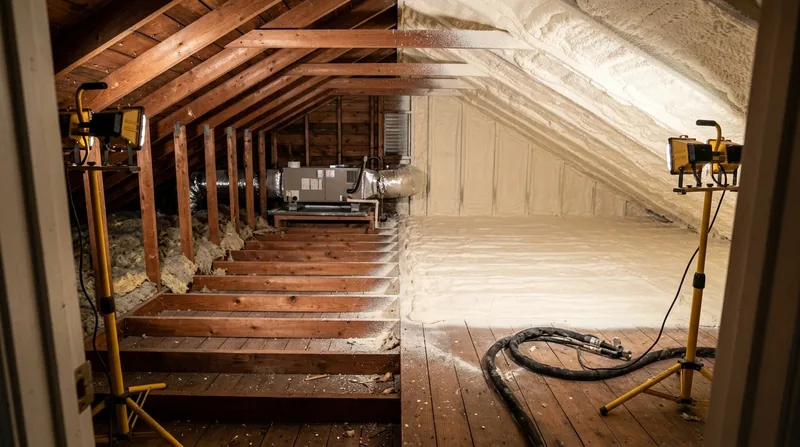




Atlanta's humid subtropical climate and dense urban canopy create a perfect storm for insulation failure. Your attic bakes at 130 to 150 degrees Fahrenheit from May through September; your crawl space sits on red clay that sweats year-round; and when a pine or oak comes down in a summer thunderstorm, the roof leak that follows turns fiberglass batts and blown-in cellulose into a soggy, collapsed mess within weeks. Insulation replacement and re-insulation in Atlanta is not cosmetic work. It is the full reset: old material removed, gaps air-sealed, and new foam installed to current code R-values. The right call when insulation is flattened, rodent-fouled, soaked by storm damage, or simply twenty years past its job.
Why Insulation Replacement Matters in Atlanta's Climate and Building Stock
Greater Atlanta rolls across the Piedmont on sloped lots, with homes perched over vented crawl spaces and daylight basements that stay damp. Inside the Perimeter, Craftsman bungalows and mill cottages built in the 1900s and 1930s sit on brick piers with empty wall cavities and original attic fill that has compressed to nothing. Outside the Perimeter, 1980s-2020s two-stories with vaulted great rooms and finished rooms over the garage run into thermal chaos because the insulation was never adequate to begin with. When a roof leak hits, when rodents colonize the attic, or when the original blown-in has settled into a thin, useless layer, replacement is not optional. It is the only path to controlling humidity, stopping air leaks, and holding a conditioned space in a climate where the cooling season runs nine months and the heat load is relentless.
- Flattened or compressed fiberglass and cellulose lose 40 to 60 percent of their R-value and cannot be restored by fluffing.
- Rodent droppings, urine, and nesting material in old insulation create air quality issues and require complete removal, not spot treatment.
- Roof leaks from storm damage soak batts and blown-in material, rendering them ineffective and creating mold risk if not removed and replaced promptly.
- Gaps around penetrations, rim joists, and band joists that were never sealed allow conditioned air to escape directly into unconditioned spaces.
- Settling and consolidation over 15 to 25 years reduces attic and crawl space R-values by 30 to 50 percent, inflating heating and cooling bills.
Complete replacement with spray foam and air sealing restores the thermal envelope and stops the money leak.
Key info: In Atlanta and surrounding areas like Marietta, Alpharetta, and Decatur, tree damage from summer storms is the leading cause of roof leaks that destroy attic insulation. A single wet event can render fiberglass and cellulose permanently ineffective within 48 hours. Replacement must happen before the humid season accelerates mold growth.
For more on the removal process that precedes replacement, see our insulation removal page.
How We Remove Old Insulation and Install New Foam in Atlanta Homes
Replacement starts with a complete tearout of the failed material. We remove old batts, blown-in cellulose, and compressed fiberglass by hand and with mechanical equipment, bag it, and haul it off. We then inspect the substrate for moisture, roof leaks, and structural damage. If the decking or framing is wet, we stop and address the leak first. Once the space is dry and clean, we seal all air leaks around penetrations, ductwork, rim joists, and band joists with spray foam, then install new foam to the R-value required by current code at your address. The entire job is done under mechanical ventilation, and we specify a 24 to 48 hour re-entry window before the space is occupied again. For attic spray foam insulation, we follow the same discipline.
- We remove all old insulation material, including contaminated sections, and haul it away in sealed containers.
- We inspect the attic deck, roof framing, and crawl space for active leaks, moisture, and structural compromise.
- We seal all air leaks and thermal bypasses with spray foam before the main insulation layer goes in.
- We install closed-cell or open-cell foam to the R-value specified by Georgia's energy code and your local building official.
- We run mechanical ventilation during the cure period and provide a written re-entry window of 24 to 48 hours.
The result is a tight, insulated space that holds temperature and humidity in check for 20+ years.
Example: A 1960s brick ranch in Smyrna with 2,400 square feet and a vented attic filled with settled blown-in fiberglass. We remove all old material, air-seal the rim and band joists, seal around the return air duct and supply plenum, and install 5.5 inches of open-cell foam to R-19 attic code. Total time on site: one full day. Re-entry: 48 hours. Result: R-value restored, air leaks closed, attic temperature drop of 15 to 20 degrees by mid-summer.
Learn more about closed-cell spray foam insulation if your space has moisture or condensation risk.
Insulation Replacement & Re-Insulation Methods and Approaches
| Approach | Description | Best for |
|---|---|---|
| Removal and Open-Cell Foam | Complete tearout of old material; air sealing of penetrations and thermal bypasses; installation of open-cell spray foam at R-19 or R-21 attic code. | Attics in sound condition with no active moisture; cost-sensitive retrofit; sound dampening desired. |
| Removal and Closed-Cell Foam | Complete removal of failed insulation; aggressive air sealing; installation of closed-cell spray foam at R-25 to R-30 for moisture control and thermal performance. | Wet or damp attics; crawl spaces over clay; rim and band joists; any space where condensation or humidity is a risk. |
| Selective Removal and Top-Up | Removal of contaminated sections only; air sealing of identified leaks; installation of foam to bring total R-value to code minimum. | Attics with localized damage (roof leak over one section); original insulation still sound in most areas; budget constraints. |
| Crawl Space Encapsulation with Foam | Removal of old batts and debris; installation of closed-cell foam on rim and band joists; foam on foundation walls and under band joists to create a conditioned, sealed crawl space. | Damp crawl spaces under brick ranches and older homes; humidity control; rim joist insulation and moisture barrier in one step. |
Insulation Replacement and Re-Insulation Cost in Atlanta: What to Expect
Insulation replacement pricing depends on the size of the space, the type and amount of old material to remove, the R-value required by code at your address, and access. A typical attic in a 2,000 to 2,500 square foot home in Atlanta, Brookhaven, or Johns Creek runs from $2,800 to $5,500 for complete removal and replacement with open-cell or closed-cell foam. Crawl spaces and rim joist work start lower but scale quickly with square footage and moisture complexity. The single biggest cost driver is removal: if the old insulation is contaminated, wet, or packed tight, tearout takes longer and costs more. The second driver is R-value: closed-cell foam costs more per board foot than open-cell, but delivers higher R-value and moisture control in damp spaces.
We provide a written estimate that specifies the R-value, thickness in inches, board-foot volume, and the cost for your specific job. We do not quote per-square-foot or per-board-foot rates over the phone because spray foam is measured on site and the scope changes once we see the space. Get 2 to 3 estimates from contractors in your area and compare the R-value and thickness specs, not just the price. A bid with no R-value number and no thickness is a red flag. Visit our pricing page for more detail on what moves the cost up or down.
Cost example: A 1,200 square foot attic in Decatur with 4 inches of settled fiberglass, rodent droppings, and no air sealing. Removal, air sealing of rim joist and penetrations, and 5.5 inches of open-cell foam to R-19: approximately $3,200 to $3,800. Same attic with closed-cell foam to R-25 and moisture barrier: approximately $4,200 to $5,000. Crawl space under a brick ranch in Sandy Springs, 1,800 square feet, with rim and band joist foam and partial foundation wall coverage: $3,500 to $4,500.
Insulation Replacement and Re-Insulation Near Me: What Atlanta Homeowners Should Know When Hiring a Contractor
The insulation trade has its share of fly-by-night outfits and rig-and-run crews that spray a job in an afternoon, collect payment, and disappear if the smell does not fade or the foam settles. The difference between a local shop and a mobile trailer is accountability. When you hire a contractor, verify that they are fully insured and can provide a current certificate of insurance. Ask for references from jobs done in your neighborhood in the last 12 months, and call them. Ask about the estimate process: does it include R-value, thickness, and board-foot specs? Does the contractor require a site visit before quoting, or do they give prices over the phone? A real estimate requires a look at your space.
Permitting varies by city across Greater Atlanta. Some cities require a permit for attic and crawl space work; others do not. Your local building department has the final say. We help you understand what applies at your address, but the permitting and contractor registration rules are set by your city, not by us. If your home is in an HOA with architectural rules, check whether exterior work on metal buildings or rim joist foam requires approval. If you have protected trees on your property, ask your city whether any work near the tree canopy or root zone needs a permit or arborist sign-off. These are rare for insulation work, but better to ask upfront than to stop mid-job.
- Ask for a detailed written estimate that includes R-value, thickness in inches, square footage, and board-foot volume.
- Request references from three jobs completed in your area in the last 12 months and call them to ask about quality, timeline, and cleanup.
- Verify that the contractor carries general liability and workers compensation insurance and can provide proof on request.
- Confirm that mechanical ventilation will run during the cure period and ask for a written re-entry window before the space is occupied.
- Check with your city building department to learn whether your address requires a permit for attic, crawl space, or rim joist insulation work.
- If your home is in an HOA, review the architectural guidelines for any restrictions on exterior work or foundation-level foam installation.
Ready to move forward? Call us at (678) 931-8735 for a free, no-obligation estimate. Contact us to schedule a site visit in Atlanta, Marietta, Alpharetta, Roswell, Sandy Springs, Johns Creek, Decatur, Smyrna, or any of our service areas.
Insulation Replacement & Re-Insulation in Atlanta: Pricing Guide
| Service | Price | Details |
|---|---|---|
| Attic insulation replacement, open-cell foam | Starting at $2,800 | Removal of old material, air sealing, and 5.5 inches open-cell foam to R-19 attic code; 1,200 to 1,500 square feet |
| Attic insulation replacement, closed-cell foam | Starting at $3,600 | Complete removal, air sealing, and 5.5 to 6 inches closed-cell foam to R-25 to R-30; includes moisture barrier for damp spaces |
| Crawl space rim and band joist foam | Starting at $1,800 | Removal of old batts, air sealing, closed-cell foam on rim joists and band joists; 800 to 1,200 linear feet of perimeter |
| Full crawl space encapsulation with foam | Starting at $3,500 | Rim and band joist foam, foundation wall coverage, and partial floor insulation; 1,200 to 1,800 square feet of crawl space |
| Selective removal and top-up | Starting at $1,500 | Removal of damaged sections only, air sealing of identified leaks, and foam to bring total R-value to code minimum |
| Free estimate | No cost | Site visit, written estimate with R-value and thickness specs, response within 24 hours; call (678) 931-8735 |
Indicative pricing, the exact cost depends on square footage, finish, and site access. Free personalized estimate within 24h at (678) 931-8735.


