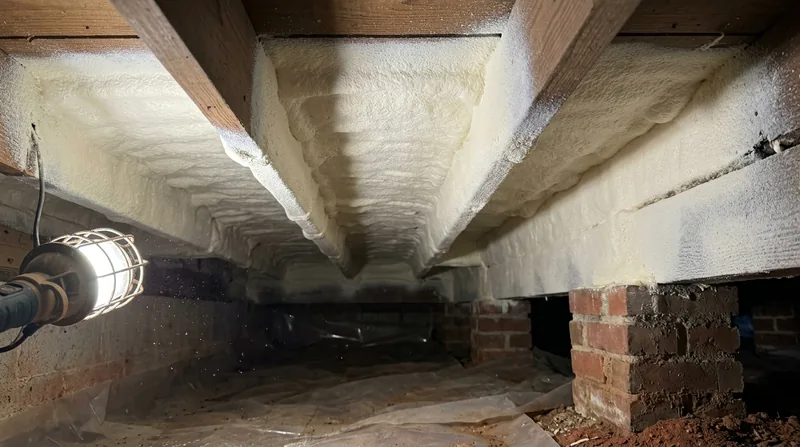




Crawl Space Spray Foam Insulation in Atlanta stops moisture and mold at the source. Atlanta's red-clay Piedmont sits beneath homes raised on brick piers, and that gap between ground and floor joists collects humid air that swells hardwood, feeds mold, and makes upper rooms clammy no matter how hard the air handler runs. Closed-cell foam on the rim and crawl space walls holds back that moisture, seals the thermal boundary, and leaves the termite inspection strip your pest bond requires. We fix moisture first, never spray over wet, and our estimates include R-value and thickness specs so you know exactly what you're getting.
Why Crawl Space Spray Foam Insulation Matters in Atlanta's Red-Clay Landscape
Atlanta's humid subtropical climate and sloped terrain create a perfect storm for crawl space problems. Rain soaks the red clay, moisture wicks up through brick and concrete, and the uninsulated crawl space becomes a humid cavity that pulls damp air into the house above. Fiberglass batts absorb moisture and collapse. Blown-in cellulose gets soggy and loses R-value. Closed-cell foam, sprayed at the right thickness, seals the air leaks and resists moisture absorption so the crawl space stays dry and conditioned.
- Stops moisture migration through rim joists and band joists that sit directly on concrete.
- Creates an air barrier that prevents humid crawl space air from rising into conditioned rooms above.
- Holds its R-value even in high-humidity conditions, unlike fiberglass or cellulose.
- Leaves the termite inspection strip exposed so your pest control bond stays valid.
- Reduces the strain on air handlers that work harder to dehumidify a leaky crawl space.
A properly sealed crawl space with closed-cell foam lowers humidity, protects floor joists, and stabilizes the temperature of rooms above, especially in neighborhoods like Decatur, Smyrna, and East Atlanta where 1950s-60s ranches sit on vented crawl spaces that were never meant to handle modern cooling loads.
Key info: Georgia's building code allows spray foam in crawl spaces when applied over a moisture barrier or substrate that is confirmed dry. Moisture testing is not optional. The local building department in your city (Atlanta, Marietta, Alpharetta, or elsewhere in your jurisdiction) has the final say on substrate prep and thermal barrier requirements. We verify what applies at your address and help you navigate permitting.
For more on how closed-cell spray foam insulation performs in moisture-heavy applications, see our closed-cell insulation service page.
How We Insulate Crawl Spaces in Atlanta: Process and Standards
Crawl space spray foam insulation is not a one-afternoon job. We start with a moisture assessment. If the crawl space is wet, damp, or has standing water, we stop and refer you to the appropriate contractor. If it is dry or can be dried, we prepare the substrate, apply a moisture barrier if needed, and spray closed-cell foam to the specified thickness and R-value. Mechanical ventilation runs during cure. Re-entry is 24 to 48 hours. You get a written estimate with R-value, thickness, and coverage area before we schedule.
- We inspect the crawl space for moisture, standing water, mold, and structural damage before quoting.
- We confirm the substrate is dry and clean, and install a moisture barrier if the local building official requires it.
- We spray closed-cell foam at the specified thickness per pass, using proper drum temperature and air ratio.
- We run mechanical ventilation during the cure period to manage off-gassing and ensure safe re-entry timing.
- We apply a thermal barrier (typically intumescent paint or fire-rated drywall) if the foam is in a conditioned space or if code requires it at your address.
- We leave the termite inspection strip exposed and mark it clearly so your pest control provider can access it.
The entire job, from moisture assessment to final walkthrough, is documented in writing. You own the estimate and the work order, and we stand behind the installation with a workmanship warranty.
Local example: A 1960s brick ranch in Brookhaven with a vented crawl space and soft floor over the garage. The crawl space humidity was 75 percent, the band joist was uninsulated, and the floor felt cold in winter. We sealed the rim and band joists with closed-cell foam, insulated the crawl space walls, and left the piers and inspection strip clear. The homeowner's humidity dropped to 55 percent, the floor warmed up, and the air handler ran less. That job is typical for Brookhaven, Dunwoody, and Smyrna.
For details on how we handle rim and band joist insulation as part of a crawl space project, visit our rim joist and band joist spray foam service page.
Crawl Space Spray Foam Insulation Methods and Materials
| Approach | Description | Best for |
|---|---|---|
| Closed-cell foam on rim and band joists | 2 to 3 inches of closed-cell spray foam applied to the rim board, band joist, and the top 2 to 4 feet of crawl space walls, creating an air and moisture seal at the thermal boundary. | High-humidity crawl spaces, homes with moisture problems, and crawl spaces in areas with heavy rainfall or high groundwater. |
| Closed-cell foam on full crawl space walls | Closed-cell foam applied to the full height of crawl space walls (6 to 8 feet), creating a fully conditioned, sealed crawl space that acts like a buffer zone. | Older homes with damp crawl spaces, finished basements or rooms above crawl spaces, and properties where floor stability and humidity control are critical. |
| Closed-cell foam with moisture barrier prep | Installation of a moisture barrier (polyethylene sheeting or similar) on the crawl space floor before foam is applied to rim and walls, reducing moisture rise from the soil. | Crawl spaces with marginal moisture levels, areas with poor drainage, and homes where the building code or local official requires a moisture barrier under foam. |
| Rim and band joist foam only | Closed-cell foam applied only to the rim board and band joist (2 to 3 inches), leaving crawl space walls uninsulated but sealing the thermal bypass at the top of the crawl space. | Budget-conscious homeowners, crawl spaces that are already relatively dry, and homes where the primary goal is to stop drafts and air leaks at the rim. |
Each approach is priced and scheduled based on the square footage of the crawl space, the height of the walls, the condition of the substrate, and local code requirements. We provide a written estimate that breaks down the R-value, thickness, and coverage area so you can compare apples to apples.
Crawl Space Spray Foam Insulation Cost in Atlanta: What to Expect
Crawl space spray foam insulation in Atlanta typically starts at $2,500 for a rim and band joist seal on a small to medium home, and rises from there depending on the scope. A full crawl space wall insulation job on a larger home or a property with moisture remediation can run $5,000 to $12,000 or more. The main factors that affect cost are the square footage of the crawl space, the height of the walls, whether a moisture barrier needs to be installed, the thickness and R-value specified, and whether the substrate needs cleaning or repair before foam is applied.
Access also matters. A crawl space with a small opening, low headroom, or obstacles (HVAC ducts, plumbing, electrical) takes longer and costs more than an open, accessible one. If the crawl space is damp and needs to dry out or be cleaned before we can spray, that adds time and cost. Getting 2 or 3 written estimates from different contractors is the best way to understand what the market charges for your specific crawl space and to compare what is included at each price.
We offer free estimates with no obligation. Call (678) 931-8735 or request an estimate online, and we will schedule a walkthrough, assess your crawl space, and provide a detailed quote with R-value and thickness specs. For a full pricing overview and examples across all our services, see our pricing page.
Crawl Space Spray Foam Insulation Near Me: What to Look for When Hiring a Contractor
Hiring the right spray foam contractor is as important as the product itself. A poorly installed crawl space foam job can trap moisture, off-gas for months, or fail to seal the thermal boundary, leaving you with the same drafts and humidity problems you started with. Before you book, verify that any contractor you hire, including us, has current insurance, can provide references, and understands the local building code and permit requirements at your address.
- Ask for proof of current general liability and workers compensation insurance, and verify it covers spray foam work.
- Request written estimates from at least two contractors that include R-value, thickness in inches, and coverage area in square feet.
- Ask for references from recent crawl space jobs in your neighborhood and follow up with at least two.
- Confirm that the contractor understands your local building code and permitting requirements, and will help you navigate what applies at your address.
- Verify that the contractor uses mechanical ventilation during cure and specifies a re-entry window of 24 to 48 hours.
- Check that the estimate addresses moisture assessment and substrate prep, and does not promise to spray over wet or contaminated crawl spaces.
A contractor who shows up with a spray gun and no inspection, quotes a price with no R-value or thickness, or promises immediate re-entry is a red flag. The best contractors, including ours, take time to assess the crawl space, prepare the substrate properly, and stand behind the work with a written warranty. Contact us today for a free estimate and to ask any questions about our process, insurance, or local experience.
Crawl Space Spray Foam Insulation in Atlanta: Pricing Guide
| Service | Price | Details |
|---|---|---|
| Rim and band joist foam seal | Starting at $2,500 | Closed-cell foam on rim board and band joist only, 2 to 3 inches, typical for 1,200 to 1,800 square foot homes |
| Partial crawl space insulation | Starting at $4,200 | Closed-cell foam on rim, band joist, and lower 4 feet of crawl space walls, moisture assessment and substrate prep included |
| Full crawl space wall insulation | Starting at $6,500 | Closed-cell foam applied to full height of crawl space walls, moisture barrier if required, full thermal and air seal |
| Large or complex crawl space project | On estimate | Full encapsulation, moisture remediation, structural repairs, or unusual access issues require on-site assessment before pricing |
| Travel and scheduling | Included | No mileage fee or travel charge within Atlanta and surrounding service areas; free estimate response within 24 hours |
Indicative pricing, the exact cost depends on square footage, finish, and site access. Free personalized estimate within 24h at (678) 931-8735.


